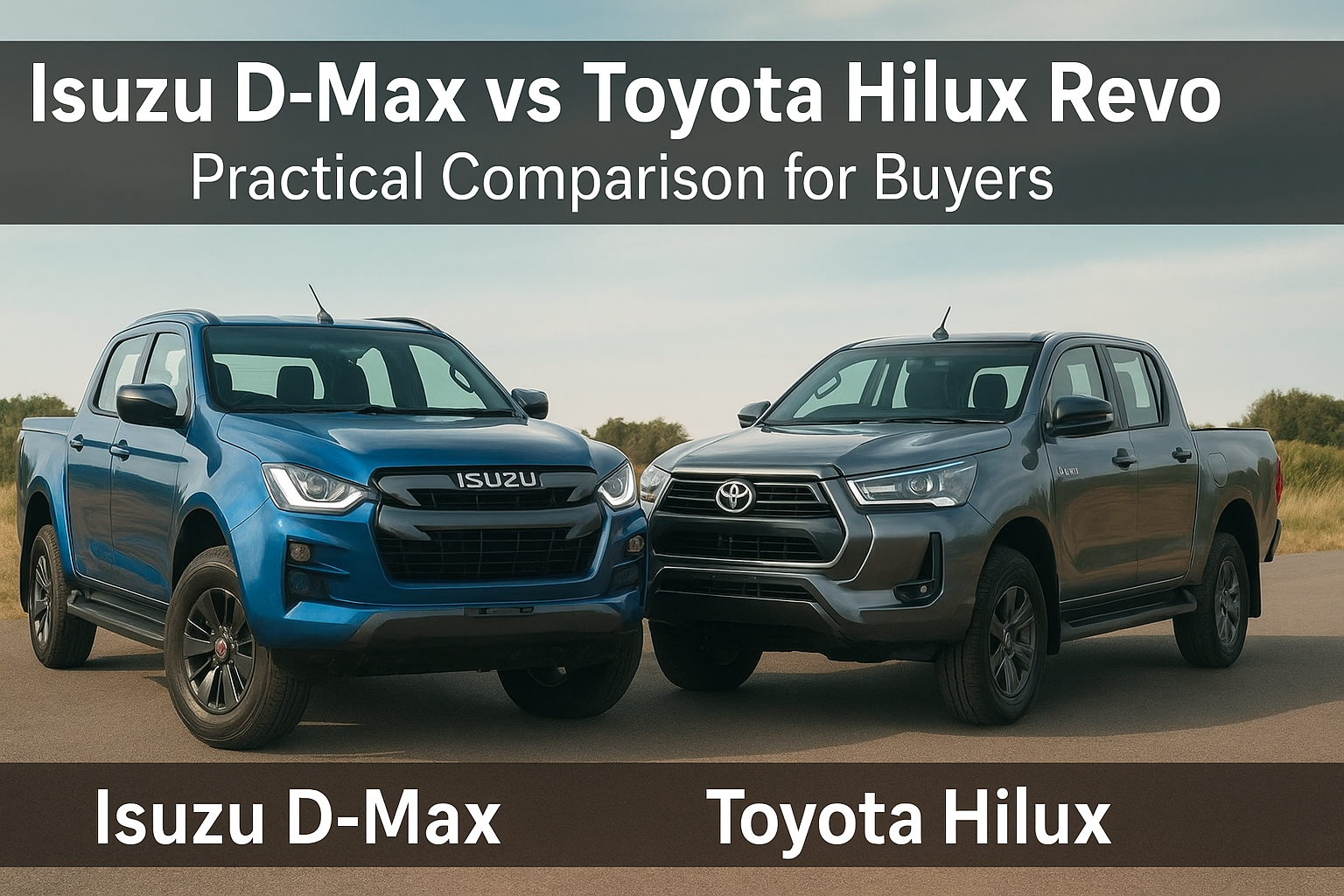
When shoppers debate the
Isuzu D-Max vs the Toyota Hilux Revo, they’re really weighing two well-established workhorses with different strengths. Both nameplates have deep brand legacies, loyal followings, and versions that appeal to everyday owners as well as commercial operators. We will discuss brand legacy, design, comfort, engines, safety, price, and the consumer trends influencing buyer choices, all in a clear and conventional tone.
Brand Legacy and Market Presence
Toyota’s reputation for durability and broad global reach gives the Toyota Hilux huge recognition.
Toyota remains the world’s top-selling automaker, selling roughly 10.8 million vehicles in 2024, which helps explain why the Toyota Hilux pickup truck is so widely trusted and available.
Isuzu’s image is rooted in commercial toughness. The Isuzu D-max (often referred to simply as Isuzu D-max by buyers) and especially the
Isuzu D-Max pickup truck has long been favoured where payload, low running cost, and simplicity matter. In some markets, notably Africa and parts of Asia and Australia, Isuzu and the D-Max have a commanding share of commercial buyers. For example, in Kenya in 2024, Isuzu held a large portion of the market while Toyota also showed strong gains, demonstrating both brands’ local strength.
Exterior Design and Build Quality
Styling is subjective, but functional cues dominate here. The Hilux Revo typically leans toward a rugged, refined look: muscular wheel arches, chrome trims on higher grades, and a design that balances daily driving comfort with off-road credibility. The
Isuzu D-Max pickup truck takes a more utilitarian, no-nonsense approach, with squared-off panels, heavy-duty bumpers, and body-on-frame robustness that signals commercial intent.
Build quality for both is high in their core markets. Toyota often emphasises fit-and-finish and corrosion protection, while Isuzu focuses on chassis strength and longevity under heavy loads.
Interior Comfort and Technology
Modern Hilux Revo cabins are usually a step up in trim fit and infotainment. Expect touchscreen systems, better noise insulation in higher grades, and more creature comforts on the Toyota Hilux pickup truck, especially in premium trims. The
Isuzu D-max puts practicality first: durable seat materials, easy-to-clean surfaces, and user-friendly controls. For buyers prioritising daily comfort and gadgetry, Hilux often has the edge; for straightforward durability and lower long-term ownership fuss, the D-Max is tough to beat.
Engine Performance and Powertrain
Both trucks offer diesel engines tuned for torque rather than outright horsepower. Toyota’s powertrains are famed for smoothness and longevity, often paired with refined transmissions that suit mixed driving. Isuzu’s engines, conversely, are tuned for fuel efficiency and heavy-duty torque delivery, ideal if you regularly tow or carry heavy loads.
Real-world fuel economy and service intervals can vary by market and model year, so prospective buyers should compare the specific engine/transmission pairs available locally.
Safety and Reliability
Safety kit varies by trim, but both brands now offer modern aids like multiple airbags, stability control, and driver assistance features on higher grades. Toyota’s resale reputation and strong dealer network often translate into perceived reliability and easier long-term support. Isuzu’s reliability record is excellent in commercial contexts where frames, axles, and engines are pushed hard for long hours; many owners praise the D-Max for staying mechanically simple and repair-friendly.
Price and Value for Money
Pricing depends heavily on country, trim level, and options. Generally, base D-Max models tend to be competitively priced with a focus on payload/value, while Hilux variants, especially the better-trimmed Revo versions, command a premium for features and badge appeal. Consider the total cost of ownership (fuel, servicing, parts availability, and expected resale), where Hilux’s brand premium often holds better resale values, while Isuzu can save money through lower running costs for heavy-use owners.
Consumer Preferences and Market Trends
Market data shows varied preferences by region. In markets like Kenya, both Isuzu and Toyota are major players, with Isuzu holding a substantial slice of the market and Toyota making significant gains. These dynamics reflect buyers choosing either the
Isuzu D-Max pickup truck for commercial robustness or the Toyota Hilux for broad versatility and higher-spec comfort.
Globally, pickups remain enormously popular. The Hilux consistently ranks among the world’s best-selling pickups outside North America, buoyed by Toyota’s global footprint, a factor that keeps it highly visible and easy to service in many countries.
Conclusion
If your day involves heavy towing, commercial hauling, or you want the simplest, most serviceable truck, the
Isuzu D-Max pickup truck is a sensible pick: it’s built to last under load and designed with long-term utility in mind. If you want a balanced package with slightly more comfort, stronger resale, and a huge global support network, the Toyota Hilux or Toyota Hilux pickup truck is hard to beat.
Both trucks are excellent; the best choice depends on priorities: payload and low running cost, Isuzu D-Max pickup truck, versus comfort, dealer depth, and broad-market appeal, Toyota Hilux. Test-drive both in the trim you plan to buy, check local servicing costs, and compare real-world fuel and maintenance figures, which will make the decision practical and personal.