
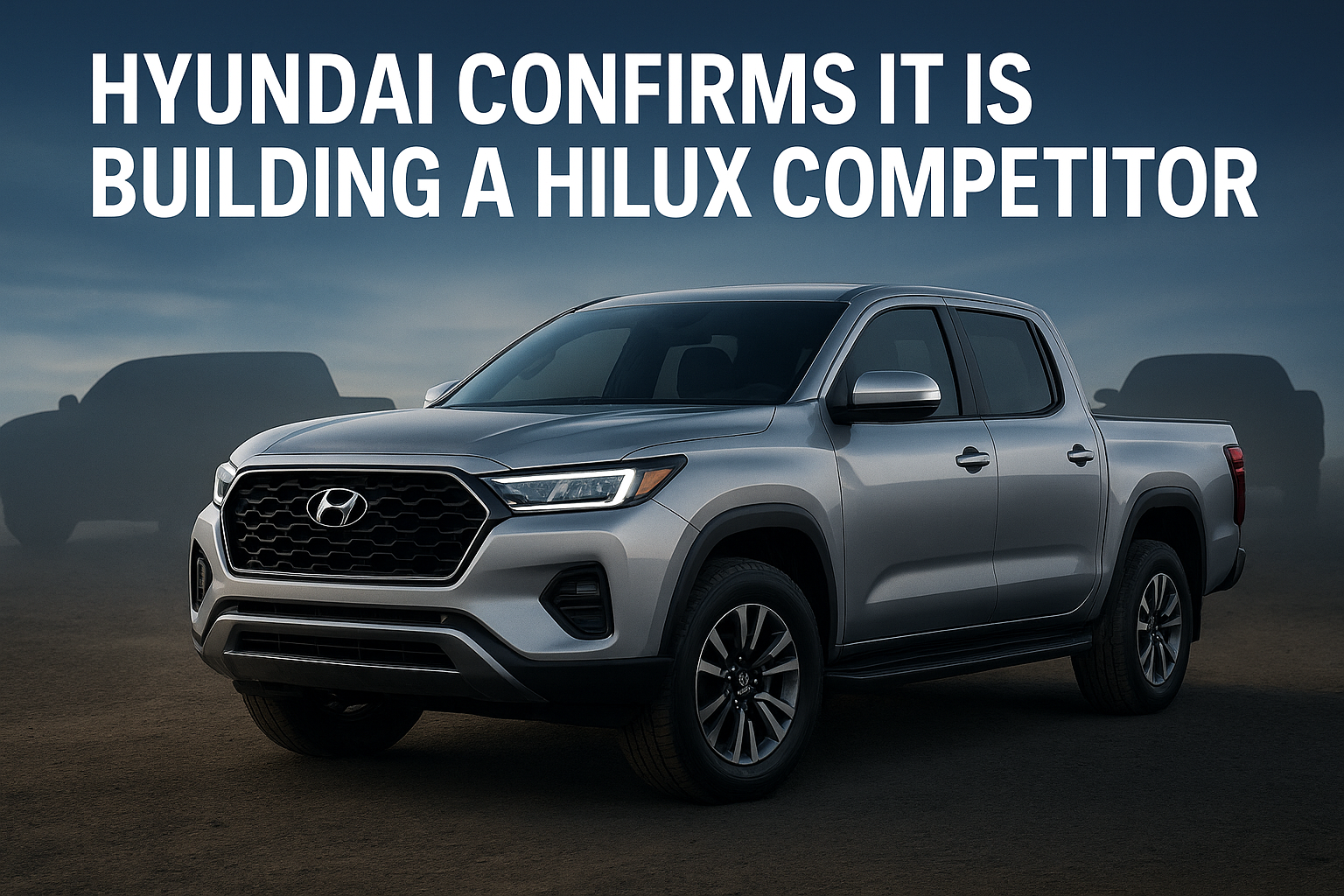
Hyundai Confirms It Is Building a Hilux Competitor
In a move that’s sure to stir the pickup world, Hyundai has officially confirmed it will produce a mid-size, ladder-frame (body-on-frame) pickup truck. This is no small announcement: the new Hyundai pickup truck is intended to rival stalwarts like the Toyota Hilux and Ford Ranger 4x4 in markets around the globe.
Hyundai’s pickup, part of its broader collaboration with General Motors to jointly develop five new vehicles, will likely skip conventional diesels and lean more into petrol hybrid or plug-in hybrid (PHEV) powertrains. The key question now: can Hyundai really capture a significant share in the domain of the Toyota Hilux pickup truck or Ford Ranger?
What we know (so far)
First, some background. Hyundai’s CEO recently told investors that the company plans to launch a body-on-frame midsize pickup before 2030 (for U.S. markets, at least). Unlike its existing Santa Cruz (which is unibody and more of a lifestyle truck), this upcoming model is intended to offer tougher truck credentials. Hyundai also appears to have a separate joint-venture with GM for Latin American and commercial markets, but the U.S./global midsize pickup would be an in-house development. Rumors point to the use of hybrid or PHEV systems (possibly borrowed from Hyundai’s existing SUV/hybrid technologies) rather than a heavy reliance on diesel. All that said, Hyundai is entering a fiercely competitive space. The Toyota Hilux has long been a reference point for toughness and durability, particularly in off-road or developing markets. Meanwhile, the Ford Ranger 4x4 has gained ground in many regions, especially where buyers favor modern features and performance. In May 2025, for instance, Ford moved 4,481 units of Ranger 4x4 in Australia, while Toyota managed 4,208 HiLux 4x4s in that same month. To give a broader view, the Hilux still remains one of the world’s top-selling pickups. According to recent data, it holds the number three spot globally (behind Ford F-Series and Silverado) and has seen slight growth (+0.5 %) in share.Strengths Hyundai Could Leverage
Hyundai enters with some real advantages if it plays its cards right:Electrified powertrains
By skipping (or minimizing) diesel and leaning on hybrid / PHEV systems, Hyundai can position its truck as more future-proof, cleaner, and potentially more appealing in markets with emissions regulations. If it marries strong torque with good fuel economy, that’s a compelling combo in the pickup world.Modern Features & Tech Expectation
Hyundai has built up a reputation for packing tech, safety aids, connectivity, and comfort into its cars and SUVs. If those strengths carry over into its pickup, it might sway buyers who want “truck capability + modern convenience.”Global Scale and Economies
With Hyundai’s global footprint and manufacturing network, it may be able to offer competitive pricing (or at least mitigate cost disadvantages) compared to more entrenched rivals.New Brand Appeal
In markets where Hyundai is seen as a modern, aspirational brand, a well-executed new Hyundai pickup truck could attract buyers looking to break from “old school” trucks.Challenges On The Road Ahead
The road won’t be easy. Here are some of the headwinds Hyundai must face:Brand Trust and Reputation in Tough Use Cases
The Toyota Hilux has a decades-long reputation for ruggedness, resilience in harsh conditions, and low-maintenance reliability. Many buyers choose Hilux precisely because they trust it to last under abuse. Convincing such buyers to switch to a new entrant will require not just promise, but proof.Dealer and Service Network for Heavy Use
Trucks often endure hard usage (off-road, heavy loads, rural duty). Ensuring spare parts, service competence, and rugged warranty/backing will be critical. Any weakness here could deter buyers who worry about support in remote areas.Entrenched Loyalty and Resale Value
Many buyers of Toyota Hilux pickup trucks or Ford Ranger 4x4 are repeat buyers. They often value high resale value, brand recognition, and “known quantity.” A newcomer needs to build confidence that its resale will hold.Powertrain Tradeoffs
While hybrids / PHEVs may offer lower emissions and efficiency, they often compromise a bit on torque or payload when compared with robust diesels. For heavy-duty users (towing, rugged duty), diesel still has an edge. Hyundai must ensure its chosen systems don’t lose too much in capability.Timing and Differentiation
The timing of launch and uniqueness in positioning will matter. If it comes “just another truck,” it may get lost. But if Hyundai can differentiate on powertrain, tech, or value, it may carve out space.Can It Capture the Hilux / Ranger Market?
The short answer: yes, but only if Hyundai executes aggressively and thoughtfully. Let’s look at what it would take.In Mature Markets (Australia, the Middle East, Africa, Southeast Asia)
These are strongholds of the Toyota Hilux pickup truck. For example, in South Africa, through April 2025, the Toyota Hilux sold 10,943 units, while the Ford Ranger sold 7,933 units in the same period. That’s a substantial lead for Hilux in many regions. Also, in markets like Australia, the Ranger has recently overtaken HiLux in volume, reflecting shifting tastes. To win, Hyundai must deliver equal or better:- Reliability under abuse
- Parts network in remote and rural areas
- Competitive pricing (or undercutting where possible)
- Resale value
- Properly rugged versions (4x4, off-road trims)