
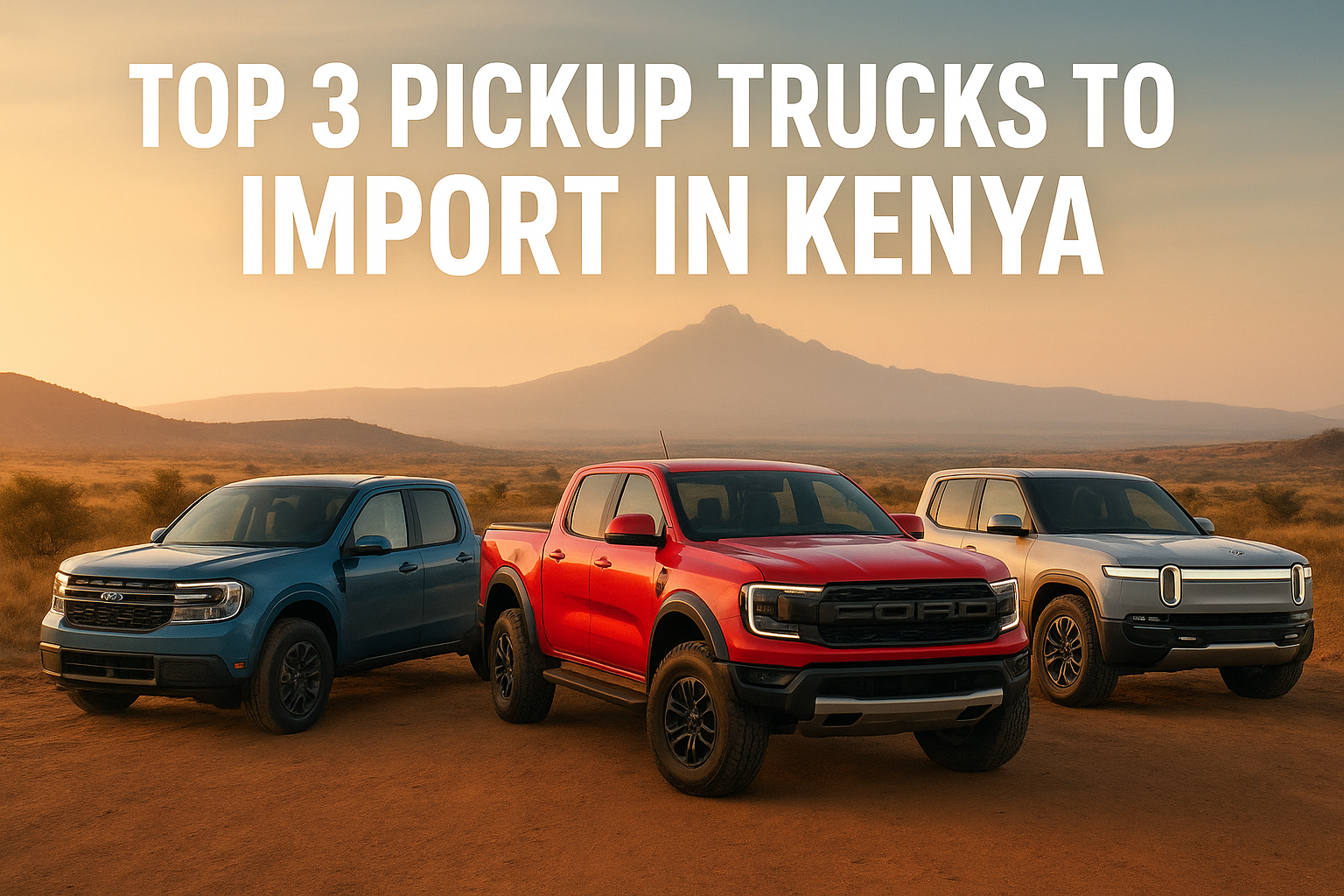
Top 3 Pickup Trucks to Import in Kenya
If you're considering importing a pickup truck in Kenya, it's essential to know that not every model is suited for the local conditions. You'll want a vehicle that can endure rough terrains, maintain fuel efficiency, and hold its value for future resale or upgrades. This guide highlights the top three pickup truck options for 2025 that we believe stand out as excellent choices for the Kenyan market.
Criteria for Choosing the Top 3
When determining which pickups are worth importing, consider the following criteria:Reliability & Durability In Harsh/Mixed Terrain
Kenya’s roads (especially outside urban centers) often shift between tarmac, gravel, mud, and steep gradients. The ideal truck must handle mixed terrain without frequent breakdowns.Fuel Efficiency + Operating Costs
Fuel is a big expense in Kenya. A relatively efficient engine (or hybrid/electric alternative) can save thousands in running costs over the years.Ease Of Finding Spare Parts Locally
Even the best truck fails eventually, you want parts that are available locally or via regional supply (East Africa) rather than waiting months for imports.Resale Value
A truck that holds value well will make you less nervous when it’s time to upgrade or resell.Import Costs & Maintenance Costs
Duties, taxes, shipping, and routine servicing (oil, filters, etc.) must be factored in so the total cost of ownership is acceptable.Features (4WD vs 2WD, Cabin Type, Load Capacity)
Does it have full-time 4WD or selectable 4WD? Single or double cab? What is the load/payload rating? These specs determine usefulness in real Kenyan use.The Top 3 Picks for Kenya (2025 models)
Here are three pickups that make the strongest case for import into Kenya in 2025:2025 Ford Maverick
The new Ford Maverick is a smaller (compact) pickup, but it offers interesting advantages for many Kenyan use cases.- Fuel Efficiency: The 2025 Ford Maverick hybrid variant boasts city ratings up to 42 mpg and highway ~35 mpg (≈ 38 mpg combined) per EPA estimates.
- Durability & Terrain: While it’s not a hardcore off-roader in base trim, Ford offers an “FX4 Off-Road” package and the Tremor version, with better ground clearance, skid plates, and an electronic locking rear differential.
- Load & Towing: Base payload ~1,500 lbs (≈ 680 kg) and towing up to 4,000 lbs (≈ 1,815 kg) in its more capable spec.
- Spare Parts & Resale: Ford has a good presence in East Africa (especially with Ranger and F-series), so consumables (filters, brake parts, etc.) may be more accessible. The “new Ford Maverick pickup” positioning also helps in brand recognition and resale.
- Trade-off: It is smaller, so for heavy loads or rugged remote terrain, you might prefer a more robust truck. But for mixed city + rural runs, it’s a compelling, balanced choice.
2025 Ford Ranger Raptor
This is the more serious pickup of the bunch, built for performance and rough terrain.- Fuel Efficiency / Operating Cost: Not great, the 2025 Ranger Raptor’s EPA estimate is ~16 mpg in city, 18 mpg highway.
- Durability & Terrain: This is its strength. The Raptor has specialized suspension, a strengthened chassis, terrain tires, and is tuned for off-road work.
- Load & Towing: Towing ~5,510 lbs (≈ 2,500 kg) and payload ~1,411 lbs (≈ 640 kg) per Ford’s claims.
- Spare Parts & Resale: Since Ford Rangers (non-Raptor) are popular in Kenya, local parts networks exist; the Raptor version might require some special parts, but shared components will help. Resale among enthusiasts will likely be strong.
- Trade-off: High fuel cost is a concern, especially for frequent long-distance travel.
2025 Rivian R1T
A bold choice: an electric luxury pickup. It offers a radically different proposition.- Fuel Economy / Operating Cost: The Rivian R1T gets extremely high MPGe, city 74 MPGe, highway 66 MPGe, in comparison. Other sources show the 2025 Rivian gets between 72 and 93 MPGe in city, and 63 to 80 on highway, depending on configuration.
- Durability & Terrain: It’s built with a robust chassis and full-time electric-drive AWD; torque on demand per wheel gives good off-road capability.
- Load & Towing: It can haul ~1,760 lbs payload and tow up to 11,000 lbs (≈ 5,000 kg) in some variants.
- Spare Parts & Resale: This is the weak link. In Kenya, EV infrastructure is still developing, and spare battery modules, EV motors, controllers, etc., will be hard to come by. Resale will depend heavily on buyer confidence and support network.
- Trade-off: High upfront cost, import difficulties, and uncertain servicing make it a risk, but for those wanting “future forward” pickups, it’s compelling.
Importing Tips & Regulations in Kenya
Before you pull the trigger on shipping one of these pickups, here’s what you must know about Kenyan import rules and costs:- Age Limit: Kenya allows imports of used vehicles only if they are not more than 8 years old from the year of first registration.
- Right-Hand Drive (RHD): All vehicles imported (unless for a special purpose) must be RHD. LHD vehicles are generally not allowed.
- Inspection & Conformity: The vehicle must meet Kenya Bureau of Standards (KS 1515:2000) inspections, and pre-shipment inspections by agents such as QISJ or JEVIC are mandatory.
- Customs Duties & Taxes: You’ll pay import duty, excise duty, VAT, Import Declaration Fee (IDF), Railway Development Levy (RDL), and other levies. Many guides put import duty rates, excise, and VAT in combined formulas.
- Valuation Method: Kenya’s KRA uses the Current Retail Selling Price (CRSP) or the invoice value (whichever is higher), then applies depreciation for customs value.
- Duty-Free Import For Returning Residents: Under certain conditions (used vehicle registered in your name for ≥ 12 months, you lived abroad ≥ 2 years, etc.), you may qualify to import one personal vehicle duty-free.
- Documentation Required: Bill of Lading, Commercial Invoice, import declaration, inspection certificate, KRA PIN, logbook, and pre-shipment inspection report.
- Recent Enforcement Tightening: As of 2025, Kenya is enforcing the 8-year rule strictly: vehicles manufactured in 2017 or earlier may be denied port entry.
- Tip: Work with a credible clearing agent in Kenya who knows the truck import market well (especially pickups). They’ll help you estimate CIF (Cost + Insurance + Freight) and duty load upfront.
Maintenance & Running Cost Advice
Here are practical tips to keep your import truck running well and cost-efficient in Kenya:- Use Local Parts When Possible: For Ford models, especially, try to use parts from Ranger/Safari/Transit lines that may share components (filters, brake pads, belts).
- Routine Checks: On rough roads, check for underbody damage, loose parts, and protective skid plate alignment.
- Fuel Strategy: Use high-quality fuel; avoid low-grade petrol/diesel, which may clog injection or turbo systems faster.
- Battery & Charging (for Rivian): If you go the EV route, ensure you have a robust charging infrastructure (solar + grid backup). Maintain battery cooling systems.
- Off-Road Wear: Suspensions, shocks, bushings, axles, and tires will wear faster in Kenya’s tough terrain. Budget for more frequent replacement.
- Insurance & Road Tax: Choose insurers who understand off-road / import trucks. Be aware of any higher premiums for exotic imports.
- Value Retention: Keep thorough maintenance records. Trucks imported with full service history and local support potential command higher resale prices.