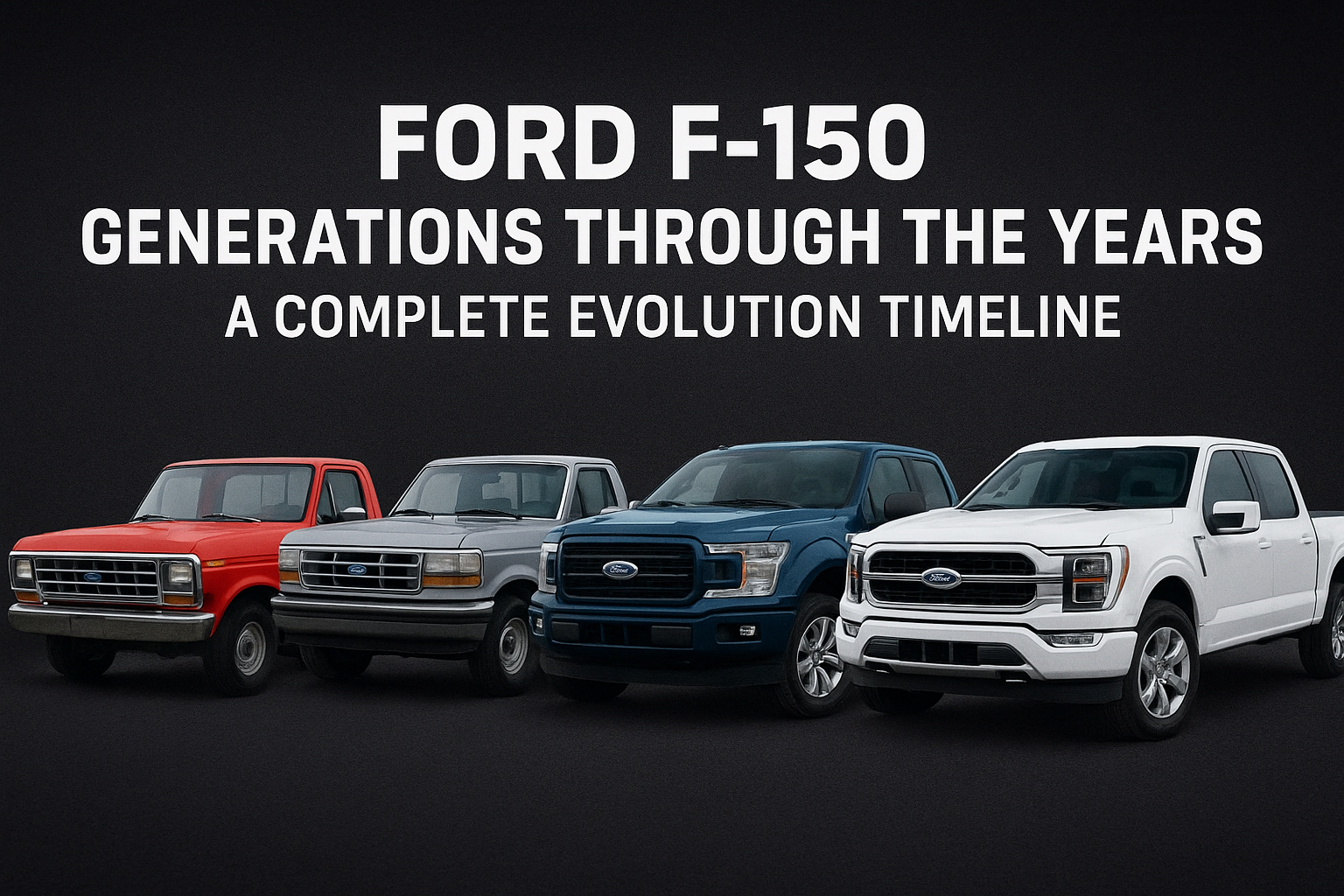
Few vehicles define American capability like the Ford F-150. As part of the legendary Ford F-Series, the
F-150 Pickup Truck has evolved through decades of engineering improvements, design transformations, and technological milestones. From its rugged post-war beginnings to today’s aluminum-bodied powerhouse, the F-150 remains an enduring symbol of strength and innovation. Here’s a complete look at its evolution through the generations.
The Birth of an Icon: F-Series Origins (1948–1952)
The journey began after World War II when Ford introduced the first-generation Ford F-Series, known as the “Bonus Built” trucks. These early models laid the foundation for what would become the Ford F-150, offering stronger frames, a more comfortable cabin, and better payload capability than earlier Ford trucks. They were utility-focused but hinted at the comfort and usability that future F-150 Pickup Truck models would deliver.
First Generation Evolution (1953–1956)
In 1953, Ford renamed its trucks with the familiar F-100, F-250, and F-350 badges. This era marked the start of the modern Ford F-Series identity. The trucks gained more refined interiors and new overhead-valve V8 engines. The design became sleeker, signaling a shift toward style and comfort—qualities that would later define the Ford F-150 experience.
The Foundation Years (1957–1966)
The fourth and fifth generations brought major upgrades, including integrated body designs, wider frames, and improved suspension. Ford also introduced its first factory-built four-wheel-drive system. According to
historical production records, Ford F-Series trucks saw a dramatic rise in consumer demand during this decade, with sales growing significantly. These years solidified Ford’s reputation for producing durable and dependable trucks.
Enter the F-150 Name: Sixth Generation (1975–1979)
One of the most important moments in the timeline arrived in 1975 with the introduction of the Ford F-150 nameplate. Positioned between the F-100 and F-250, this model was created to meet new emissions and payload requirements. The
F-150 Pickup Truck quickly became the bestseller of the Ford F-Series, largely due to its perfect balance of power and practicality.
The Square Body Era Begins: Seventh Generation (1980–1986)
The seventh generation ushered in the classic boxy “square body” styling. With improved aerodynamics, lighter chassis components, and upgraded engines, this generation made the Ford F-150 more fuel-efficient and modern. Ford also focused on better handling, making the F-150 Pickup Truck feel more car-like while maintaining its towing and hauling strength.
Refined Square Body Design: Eighth Generation (1987–1991)
Building on the previous generation, the eighth generation featured a more refined square body, aerodynamic touches, and better safety features. The interior became more comfortable, making the Ford F-150 appealing not just to workers but also to families. This era also saw electronic fuel injection become standard across the Ford F-Series, marking a significant technological leap.
The Final Square Body Evolution: Ninth Generation (1992–1997)
The ninth generation delivered smoother edges and a modernized cabin, completing the square-body era. Technology such as driver airbags and revised suspension made this the safest and most advanced
Ford F-150 yet. According to industry sales data, the Ford F-Series remained the best-selling vehicle line in America throughout this period. Its reputation for reliability only strengthened.
The Modern Era Begins: Tenth Generation (1997–2003)
The tenth generation introduced a revolutionary aerodynamic design and more passenger-friendly features. The F-150 Pickup Truck shifted from a strictly work-focused machine to a versatile everyday vehicle. Rounded edges, upgraded interiors, and new V6 and V8 engine options modernized the Ford F-150 for a new era of drivers who demanded both comfort and capability.
Technological Advancement: Eleventh Generation (2004–2008)
The eleventh generation continued the transformation with a bolder exterior, hydroformed frame construction, and advanced infotainment options. The Ford F-150 evolved into a technology-driven truck, offering improved safety systems and class-leading ride quality. This era solidified the truck’s position as the centerpiece of the Ford F-Series lineup.
The EcoBoost Revolution: Twelfth Generation (2009–2014)
With rising demand for fuel-efficient power, Ford launched the game-changing EcoBoost engines. The 3.5-liter EcoBoost V6 offered the towing strength of a V8 while improving gas mileage, forever changing the
F-150 Pickup Truck landscape. The trucks also introduced upgraded interiors, improved infotainment, and more luxury trims, appealing to a broader range of buyers.
The Aluminum Revolution: Thirteenth Generation (2015–2020)
One of the boldest innovations came in 2015 when Ford switched to a military-grade aluminum-alloy body. This cut weight by as much as 700 pounds while increasing payload and towing capability. The thirteenth-generation Ford F-150 proved that lightweight materials could deliver superior durability. Combined with next-gen EcoBoost engines and advanced driver-assist features, it became one of the most technologically advanced models in Ford F-Series history.
Current Generation Excellence: Fourteenth Generation (2021–Present)
The current generation emphasizes hybrid technology, advanced connectivity, and premium comfort. The PowerBoost hybrid model, massive digital displays, over-the-air updates, and superior towing capabilities make this the smartest and most capable F-150 Pickup Truck yet. From work sites to weekend adventures, the modern Ford F-150 continues to set benchmarks for the entire Ford F-Series.
Understanding F-150 Body Styles Through the Generations
Regular Cab
Available across almost all
Ford F-Series generations, the Regular Cab offers a simple two-door layout ideal for work-focused buyers. It's a classic design that has contributed to the versatility of the F-150 Pickup Truck since the early years.
SuperCab
Introduced to offer more interior space, the SuperCab includes rear-hinged back doors and extra seating. It bridged the gap between utility and comfort, becoming a popular option on modern Ford F-150 models.
SuperCrew
The SuperCrew, featuring full-size rear doors and spacious back seating, brought SUV-level comfort to the F-150 Pickup Truck. Since its introduction, it has become one of the best-selling configurations in the entire Ford F-Series lineup.
Conclusion
The
Ford F-150's transformation from its early utility roots to a sophisticated powerhouse highlights its enduring legacy in the automotive world. With each generation, it has adapted to meet the needs of drivers, solidifying its place as a symbol of strength, reliability, and innovation in American trucks.