
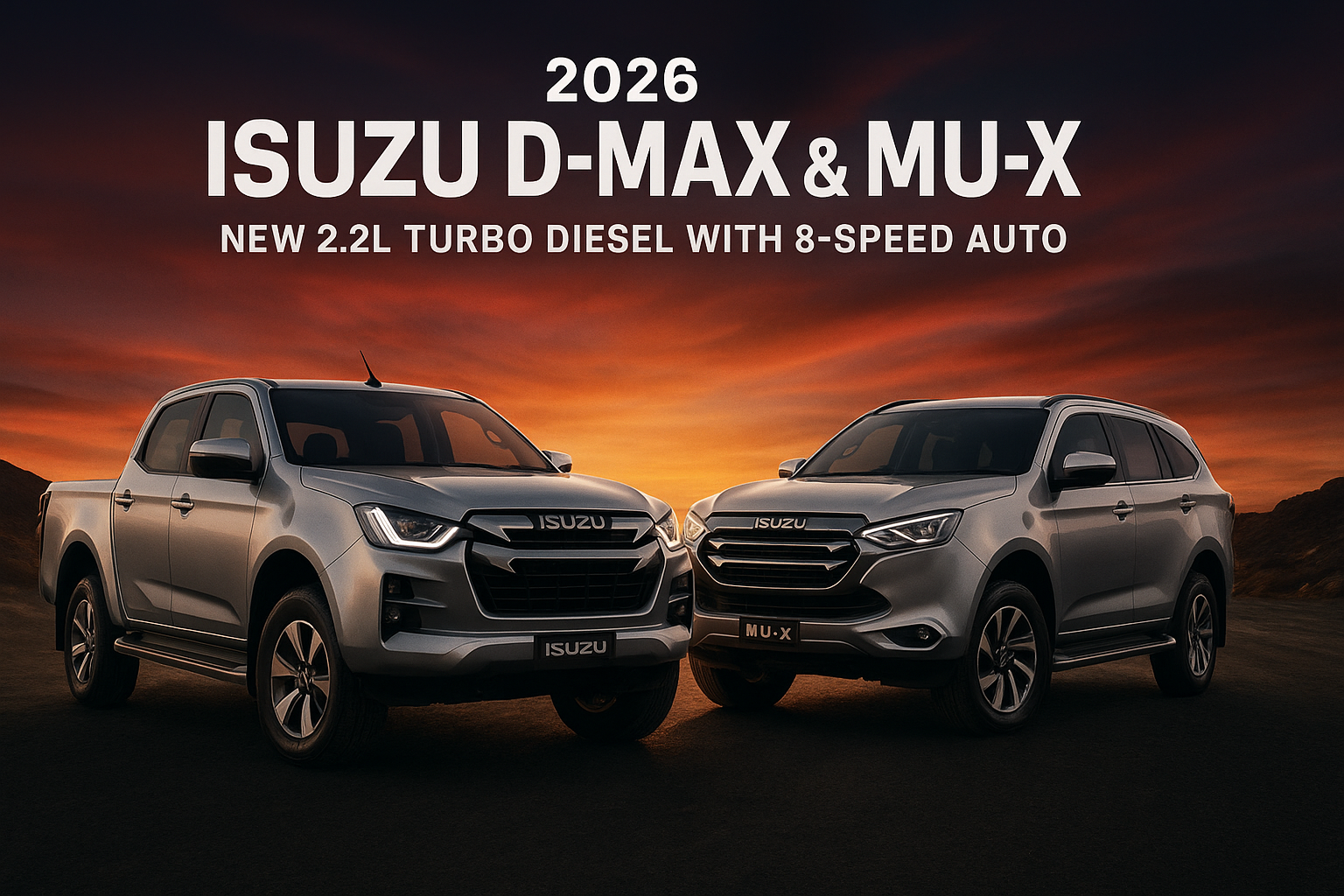
2026 Isuzu D-MAX & MU-X: Meet the New 2.2L Turbo Diesel with 8-Speed Auto
The pickup and SUV market has been buzzing with anticipation, and Isuzu has finally lifted the curtain on its latest powertrain innovation. The 2026 Isuzu D-MAX and MU-X arrive with a brand-new 2.2-liter turbo diesel engine paired to an eight-speed automatic transmission. For fans of the rugged new Isuzu pickup lineup, this marks a turning point, one that reflects both shifting customer expectations and the tightening grip of regulatory standards across global markets.
In this blog, we’ll explore what has changed, why it matters, and what challenges could come with this significant move.
A Look Back: Previous Powertrains
Before this change, Isuzu relied heavily on its tried-and-true engines: the 1.9-liter RZ4E-TC and the 3.0-liter 4JJ3-TCX diesels.- The 1.9L was designed to balance efficiency and affordability. With around 150 hp and 350 Nm of torque, it was popular among buyers who valued lower running costs over raw performance.
- The 3.0L was the heavy hitter, churning out about 190 hp and 450 Nm. It was built for towing, hauling, and customers who demanded robust durability.
Market Demands Pushing the Change
The automotive world doesn’t stand still, and Isuzu knew it needed to evolve. Market trends have been pointing toward smaller, more efficient engines that can still deliver power when needed.- Fuel Efficiency Standards: Governments worldwide have tightened efficiency and emissions requirements. According to the International Energy Agency, transport emissions account for nearly 24% of global CO2, and diesel vehicles are under increasing scrutiny.
- Customer Demand for Refinement: Buyers of pickups and SUVs don’t just want utility anymore. They also want comfort, smooth acceleration, and transmission options that don’t feel clunky.
- Competition: Rivals like Toyota, Ford, and Mitsubishi have been refreshing their lineups with smaller-displacement turbo diesels and multi-gear automatics. To remain competitive, the Isuzu D-MAX and MU-X needed to step up.
Regulatory and Emissions Pressures
Emissions regulations, particularly Euro 6d and upcoming Euro 7 standards in Europe, played a big role in shaping the new powertrain. In Southeast Asia and Australia, stricter fuel economy targets are also coming into play. While Isuzu has a loyal base in regions where emissions rules are more relaxed, the company has to think globally. The new 2.2L RZ4F-TC engine is designed not only for efficiency but also for compliance, ensuring the new Isuzu pickup lineup can continue to sell across multiple markets without costly adaptations.The New 2.2L RZ4F-TC Engine + 8-Speed Auto
So, what’s the headline? The 2.2-liter turbocharged four-cylinder diesel replaces both the 1.9L and, in some markets, even the 3.0L.- Output: Around 177 hp and 420 Nm of torque (figures may vary slightly by region).
- Transmission: An all-new 8-speed automatic co-developed with Aisin, replacing the 6-speed auto.
- Efficiency: Early estimates suggest up to 10% better fuel economy compared to the outgoing 1.9L and 3.0L.
- Emissions: Meets Euro 6d standards with selective catalytic reduction (SCR) and diesel particulate filter (DPF).
What’s Changed — Comparison with the Old Setup
The new setup introduces several enhancements compared to the old configuration. One of the most significant changes is the user interface, which is now more intuitive and easier to navigate. Users can access features more quickly, reducing the time spent on administrative tasks. Additionally, performance improvements have been implemented, resulting in faster load times and a smoother overall experience. This change directly addresses user feedback, which found the previous system cumbersome and inefficient. Another notable difference lies in the integration capabilities of the new setup. Unlike the old version, which had limited compatibility with third-party applications, the updated system supports a broader range of integrations, allowing for seamless data transfer between platforms. This flexibility enables users to tailor their workflows and enhance productivity. Enhanced security measures have also been implemented, ensuring that sensitive data is better protected against potential breaches, a concern that was previously present in the previous setup.Other Updates to the 2026 (25.5MY) D-MAX / MU-X Range
Beyond the new engine and transmission, the 2026 Isuzu D-MAX and MU-X receive a range of subtle yet meaningful updates:- Refined Interior: Better materials, new infotainment with wireless Apple CarPlay and Android Auto.
- Safety Upgrades: Improved ADAS suite with enhanced lane-keeping assist and adaptive cruise tuned for urban traffic.
- Exterior Touches: Revised grille, sharper LED headlights, and new alloy wheel designs.
- Suspension Tweaks: Small adjustments to ride comfort, especially on MU-X models.
Implications & Analysis
This shift carries big implications:- For Customers: The new Isuzu pickup delivers more balance—no need to choose between efficiency (1.9L) and performance (3.0L).
- For Isuzu’s Market Position: With rivals like the Toyota Hilux adopting 2.4L turbo diesels, Isuzu is now right in the mix.
- For the Industry: This shows that downsizing with smart turbocharging and advanced gearboxes is the future, even in rugged workhorses like pickups.
Potential Challenges & “Gotchas”
No launch is without concerns. Some potential challenges include:- Customer Perception: Longtime fans of the 3.0L might worry that the smaller engine won’t last as long under heavy loads.
- Complexity: The 8-speed automatic and advanced emissions systems could raise maintenance costs compared to the simpler old setup.
- Transition Markets: In places where fuel quality is inconsistent, the new emissions hardware may struggle, affecting reliability.