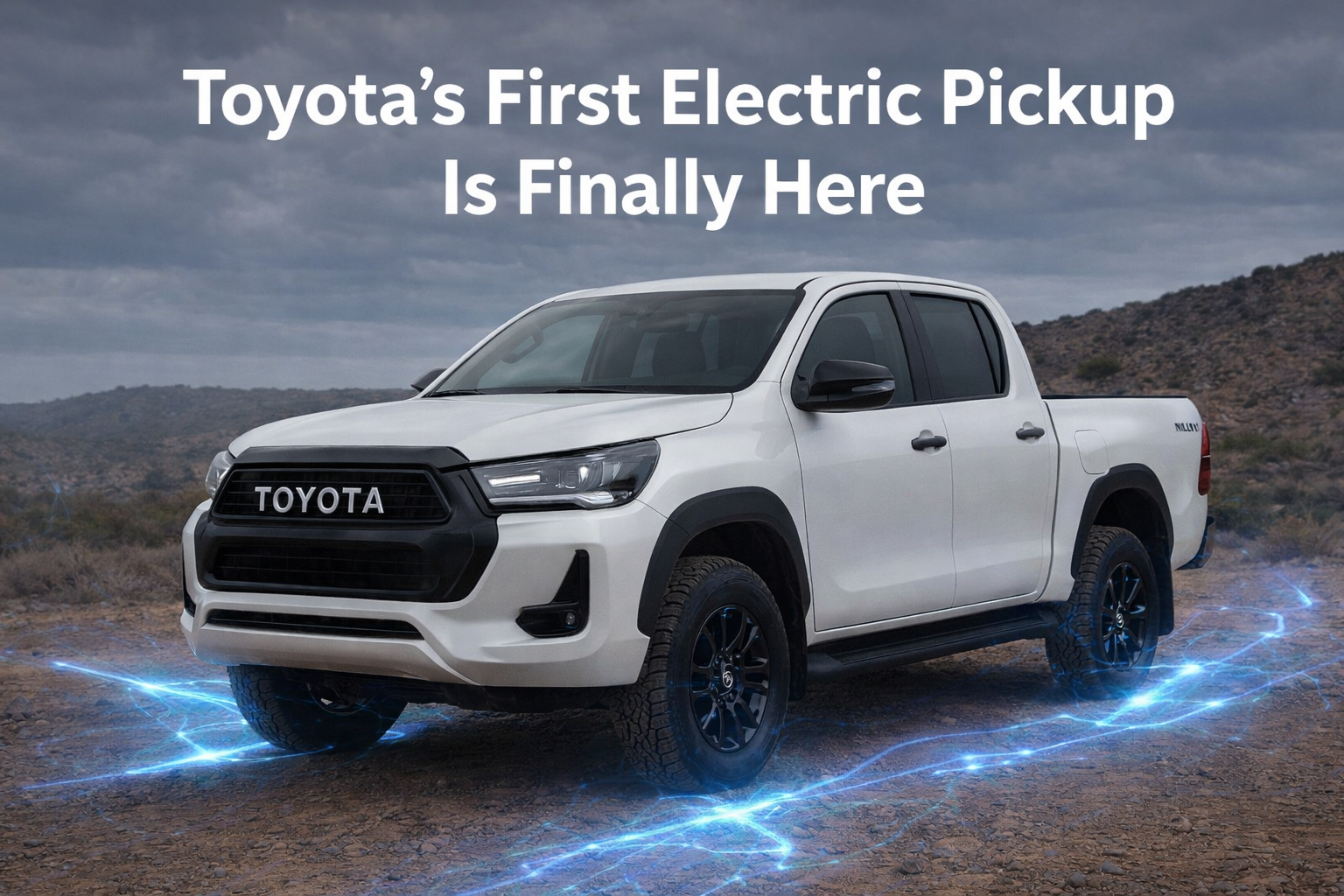
Toyota has officially unveiled the 9th-generation Hilux, and for the first time in its long history, the
iconic Toyota Hilux pickup truck comes in a fully electric form. Built on Toyota’s tried‑and‑tested IMV body-on-frame platform, the new Hilux BEV (battery-electric vehicle) retains the ruggedness that made the Toyota Hilux legendary, while embracing the future with zero-emissions powertrains.
Unlike many EVs that copy sedan or crossover platforms, this is Toyota’s first body-on-frame EV, marking a major step for its Toyota pickup truck ambitions.
Performance and Power
Under the skin, the electric Hilux packs a 59.2 kWh lithium-ion battery and a dual-motor (front and rear) setup that gives it all-wheel drive capability. Toyota claims a system output of around 193 horsepower, or 144 kW, with torque of 205 Nm at the front axle and 268.6 Nm at the rear.
In terms of towing and payload, it’s very capable: the EV version can carry up to 715 kg and tow up to 1,600 kg. Toyota also preserves its off-road heritage with a Multi‑Terrain Select system and a wading depth of 700 mm, the same as non-electric models.
When it comes to driving range, Toyota estimates around 240 km (WLTP standard) on a single charge. While that may not compete with some long-range EVs, it’s more than sufficient for many light-duty and fleet use cases.
Innovative Features
To support both ruggedness and modern usability, the
electric Toyota Hilux pickup truck introduces a number of new features:
The battery pack is mounted under the floor, helping with weight distribution while preserving cabin and cargo space.
Inside, the cabin is modernized: there are dual 12.3‑inch screens (driver cluster + central touchscreen), inspired by Toyota’s Land Cruiser design.
The EV variant is the first Hilux to adopt electric power steering, reducing kick-back in rough terrain.
Safety and driving-assist tech includes Toyota Safety Sense, with features like low-speed acceleration suppression, proactive driving assist, and an emergency driving stop system.
There is also a rear deck step and redesigned side steps for easier bed access, especially helpful for work and utility users.
Connectivity is modern too: wireless phone charging, multiple USB ports, and support for over-the-air (OTA) updates through the MyToyota app.
Market Positioning
Toyota is positioning this electric Hilux as a versatile workhorse rather than a niche luxury EV. While traditional
Toyota Hilux pickup truck fans may have expected only gasoline or diesel variants, Toyota’s multipath strategy now embraces electric, hybrid, and even hydrogen options.
In key markets like Thailand, pickup trucks make up more than 50% of local vehicle sales, so an electric Hilux makes strategic sense for fleet buyers and urban commerce. Toyota plans to launch globally, but not all markets will get every variant. According to
reports, the EV Hilux will start production by the end of 2025.
Charging Infrastructure and Range Considerations
One of the important considerations for this electric Toyota pickup truck is the charging infrastructure. Toyota has stated that it is targeting “best‑in-class” charging capabilities to reduce downtime, though it has not disclosed full charging speed details yet.
Given the estimated WLTP range of 240 km, prospective buyers will need to assess whether that fits their usage, especially for fleet users who may do daily short-haul trips, or consumers in regions with reliable charging networks. For heavier payloads or towing, the real-world range may drop, so understanding how load, driving style, and terrain affect efficiency will be important.
Environmental Impact
The shift to an electric Toyota Hilux undoubtedly has environmental benefits. By going zero-emission at the tailpipe, the EV version helps reduce greenhouse gas emissions compared to diesel or
petrol Toyota Hilux pickup truck models. Over its lifetime, per-vehicle emissions savings can be meaningful, particularly in markets where electricity is relatively clean or partially renewable.
Moreover, since Toyota continues to offer hybrid and hydrogen variants, it is not forcing a one-size-fits-all solution. This multi-pathway approach to decarbonization means that Toyota is balancing carbon reduction goals with practical market needs, which could have a broader positive impact across regions and use cases.
Consumer Expectations and Industry Impact
For longtime fans of the Toyota Hilux, the electric version may feel like a bold departure, but Toyota has clearly worked to preserve the spirit of the pickup: rugged, dependable, and ready for work. Many consumers will likely evaluate the EV based on its utility (payload, towing), charging practicality, and total cost of ownership. If Toyota can deliver on reliability, it may win over both traditional pickup buyers and EV-curious fleets.
From an industry perspective, Toyota's stepping into the electric pickup truck space is significant. The Hilux is one of the most globally recognized pickups; by electrifying it, Toyota is validating EV pickups as not just lifestyle vehicles, but serious work machines. That could encourage further development by competitors, boost infrastructure investment, and accelerate the adoption of electric light commercial vehicles.
Conclusion
Toyota’s first electric pickup marks a major milestone for the company and the Toyota Hilux legacy. The 9th-generation Hilux EV blends the toughness of the
Toyota Hilux pickup truck with modern electric power, smart features, and a forward-looking design. While the 240 km estimated range may not rival long-range EVs, its real strength lies in its utility, versatility, and emissions-free operation for daily work use.
As Toyota rolls out its global launch, many will be watching closely to see whether the EV Hilux becomes a mainstream choice for both commercial fleets and individual buyers. The combination of rugged build, zero-emissions driving, and Toyota’s trusted reputation could make this electric Hilux a significant player in the evolving pickup market.