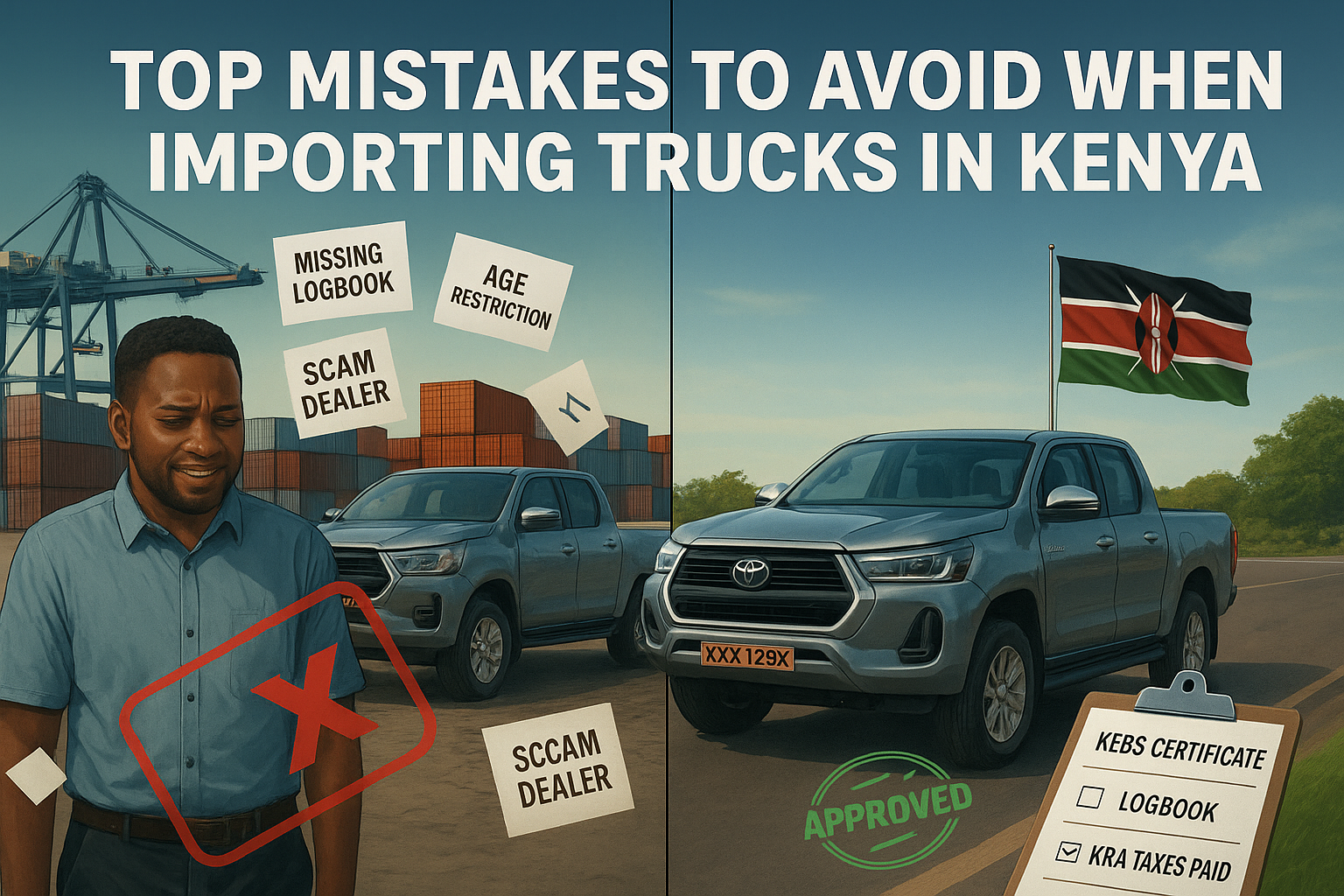
Hey there! If you’re thinking about bringing in
imported pickup trucks in Kenya, you’re probably excited about the possibilities. Whether it’s for business, farming, or personal use, getting your own truck from overseas can be a great investment. And let’s be honest, the thrill of finally getting behind the wheel of a tough
Toyota Hilux or a dependable Ford pickup truck you personally chose is unbeatable.
But here’s the thing: importing a truck isn’t just about clicking “buy” and waiting for it to arrive. There are rules, costs, and procedures that can trip you up if you’re not careful. In this guide, we’ll walk through the most common mistakes people make, what they cost, and how you can avoid them.
Mistake #1 – Ignoring Import Regulations and Age Restrictions
One of the fastest ways to run into trouble is by overlooking Kenya’s strict vehicle import rules. From January 2025 onward, only right-hand drive vehicles first registered in 2018 or later are allowed into the country. If your dream truck was registered in 2017 or earlier, KEBS will simply reject it at the port, and you’ll still be stuck paying storage or shipping costs to return it.
These rules are there for a reason: they ensure that vehicles meet safety and environmental standards. And yes, that means even if you find a bargain overseas, it’s not worth it unless it meets the regulations. Special-purpose vehicles, like ambulances or fire trucks, sometimes get exemptions, but even those have their own age and documentation requirements.
Mistake #2 – Underestimating the Total Cost
A common rookie mistake is looking only at the auction or dealer price and thinking, “I’ve got this.” But importing is like an iceberg; the part you see is tiny compared to what’s underneath. Here’s what typically comes on top of your purchase price:
- Import Duty: Usually 35% of the CIF (Cost + Insurance + Freight) value
- Excise Duty: Between 20% and 25% depending on the engine size
- VAT: A flat 16% on (CIF + Import Duty + Excise Duty)
- Import Declaration Fee (IDF): Around 3.5% of CIF
- Railway Development Levy (RDL): About 2% of CIF
Port charges, clearing agent fees, inspection fees, and local registration
If you’re importing a truck with a CIF value of 1,000,000 KES, your final cost could easily exceed 2,000,000 KES once you add duties, taxes, and fees.
According to
The Star, in 2023, Kenya imported just 78,127 vehicles, the lowest in five years and a 10.9% drop from 2022, largely due to higher costs and tighter rules.
Mistake #3 – Choosing the Wrong Truck for Local Conditions
Not all pickups are created equal. A
Toyota Hilux has a legendary reputation here; it’s tough, can handle rough roads, and has spare parts available in most towns. On the other hand, a Ford pickup truck might be a smoother ride on highways and have more tech features, but in rural areas, sourcing parts could be expensive or time-consuming.
Think about your needs before you commit:
- Will you be using it off-road often? Go for a reliable 4×4 system.
- Concerned about fuel costs? Pick an engine size that balances power and economy.
- Want low-maintenance headaches? Choose a model with widely available parts.
The “cool” choice isn’t always the “smart” choice in the long run.
Mistake #4 – Using Unverified or Scam Dealers
We’ve all heard the horror stories, fake invoices, rolled-back odometers, or trucks that look nothing like the photos. If a deal looks too good to be true, it probably is.
Protect yourself by:
- Dealing only with KEBS-approved exporters and agents
- Asking for recent inspection reports
- Checking reviews and testimonials
- Avoiding large upfront payments without clear contracts
Remember, the cheapest deal can sometimes become the most expensive mistake.
Mistake #5 – Skipping Vehicle Inspection Before Shipping
Kenya requires all used vehicles to pass a pre-shipment inspection by KEBS-approved agencies like JEVIC or QISJ. This isn’t just bureaucracy; it ensures the truck is roadworthy, the mileage is accurate, and it meets environmental standards.
If you skip this step, your truck could be denied clearance at the port, forcing you to pay for re-export or destruction. Always get the inspection done before the truck leaves the exporting country.
Mistake #6 – Poor Documentation Handling
Your truck could be in perfect condition, but without the right paperwork, it’s going nowhere. The must-have documents include:
- Original logbook (cancelled at origin)
- Commercial invoice with full details of the truck
- Bill of lading
- KEBS Certificate of Conformity or Roadworthiness
- Import Declaration Form (IDF)
- Customs entry forms
- Translations if the logbook isn’t in English
Even one missing document can result in days or weeks of costly delays. Use a reputable clearing agent to double-check everything.
How to Avoid These Mistakes
| Mistake |
How to Avoid It |
| Ignoring regulations |
Confirm registration year (2018+), right-hand drive, and KEBS compliance. |
| Underestimating costs |
Use KRA’s online duty calculator; budget for every fee, not just the truck price. |
| Wrong truck choice |
Match specs to terrain; choose models like the Toyota Hilux that have strong local support over certain Ford pickup truck variants with harder-to-find parts. |
| Scam dealers |
Use KEBS-approved exporters; verify inspection reports; avoid suspiciously low offers. |
| Skipping inspection |
Always get pre-shipment inspection from JEVIC/QISJ to avoid clearance problems. |
| Documentation errors |
Prepare all paperwork early and use a reliable clearing agent to check it twice. |
Conclusion
Importing
imported pickup trucks in Kenya, whether you’re eyeing the rugged
Toyota Hilux or the versatile Ford pickup truck, can be a smooth, profitable move if you know what to avoid.
Stick to the rules, plan for the full cost, choose the right model for your needs, work with reputable dealers, never skip inspections, and keep your documents in order. With those six steps, you’ll save yourself time, money, and frustration, and soon be enjoying your truck on Kenyan roads without a worry.