
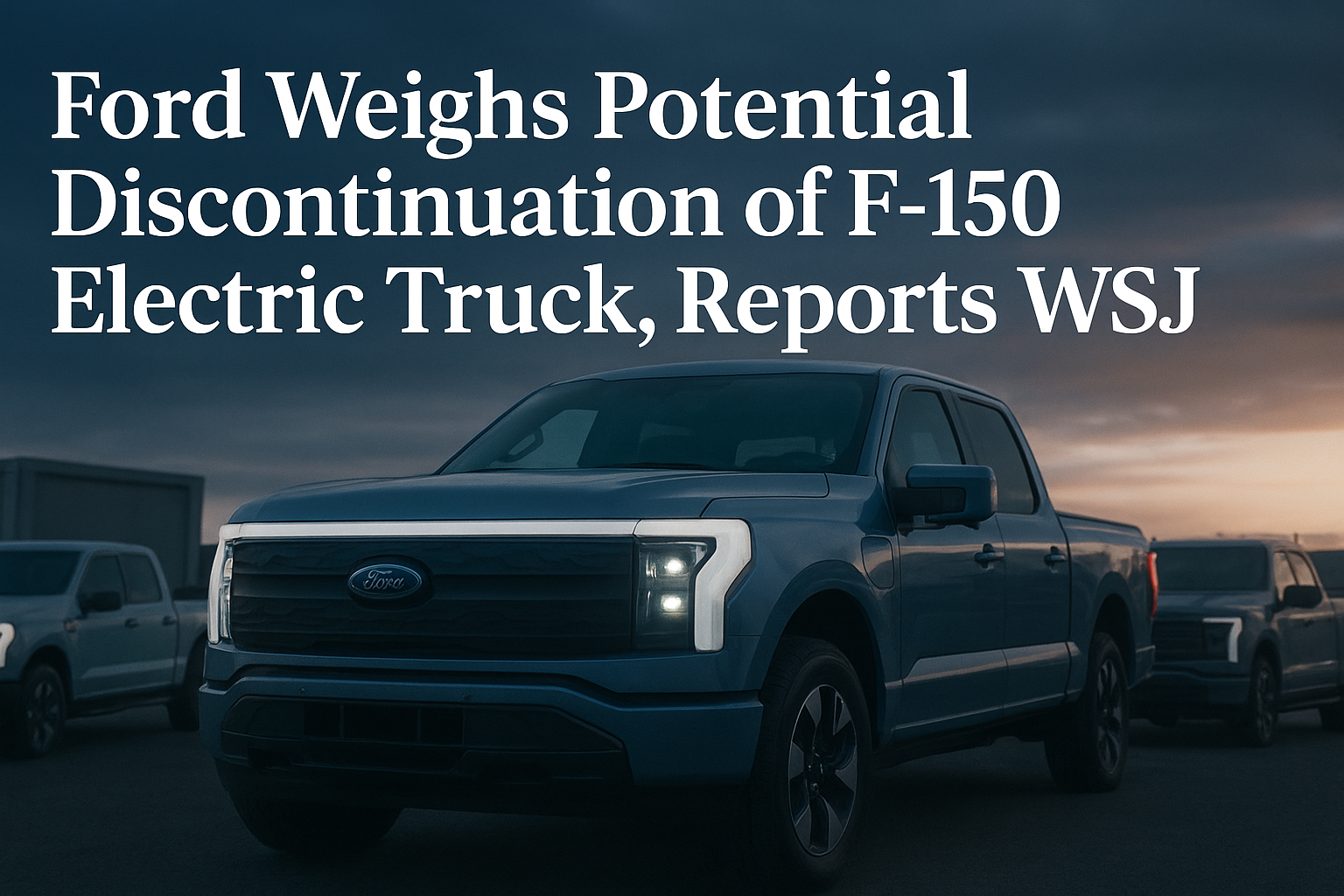
Ford Weighs Potential Discontinuation of F-150 Electric Truck, Reports WSJ
The automotive world is abuzz as Ford Motor Company reportedly considers scrapping its flagship electric truck, the Ford F-150 Lightning, a model that was meant to signal the company’s commitment to the future of the Ford F-150 family and the broader potential of the Ford pickup line. According to the Wall Street Journal, Ford executives are evaluating whether to discontinue the F-150 Lightning variant amid weak demand and mounting losses.
In this blog, we’ll walk through the background behind Ford’s electric ambitions, the reported weaknesses and challenges facing the F-150 Lightning, the strategic shift that Ford is contemplating (and its implications), the possible outcomes of this decision, and why this matters not just for Ford but for the broader industry.
Background: The F-150 Lightning and Ford’s EV Ambitions
Ford made a high-stakes bet on electrifying its iconic pickup line, positioning the F-150 Lightning as a reinterpretation of what a Ford pickup could be in an electric future. The “Ford F-150 electric” story was meant to reflect Ford’s ambitions to marry the heritage of the F-150 with the clean-energy wave sweeping the auto industry. The F-150 Lightning debuted with much fanfare, promising to bring the utilitarian capability of the Ford pickup into the electric era. For many observers, it was a bold play: the company leveraging its strongest brand, the F-150, and offering an all-electric variant to reshape expectations about trucks. The idea was that if the Ford pickup line could go electric, it would signal a broader shift. And yet, even though the F-150 Lightning initially captured headlines, the actual sales numbers and business case began to look more challenging. According to one source, the truck sold fewer than 1,500 units in October compared with about 66,000 gas-powered F-Series pickups in the same month.Reported Weaknesses / Challenges
Several interlocking issues appear to have put pressure on Ford’s electric pickup strategy:- Weak demand for large electric trucks. The F-150 Lightning struggled to convert traditional truck buyers who were accustomed to gasoline or hybrid Ford pickups. One dealer lamented: “The demand is just not there … we don’t order a lot of them because we don’t sell them.”
- Profitability concerns and high costs. Ford’s EV unit has reportedly lost billions, with one report citing roughly $13 billion in EV losses since 2023. These kinds of losses raise questions about whether the “Ford F-150 electric” variant can be sustainable within the Ford pickup business.
- Supply-chain and production disruptions. For example, a fire at an aluminum supplier forced Ford to pause production of the F-150 Lightning at its Rouge Electric Vehicle Center in Dearborn, Michigan. Limited materials, such as aluminum, have been prioritized for the more established gasoline or hybrid F-150 models.
- Pricing and positioning mismatches. The F-150 Lightning carried a premium price tag compared to standard Ford pickup models, but for many buyers, the perceived trade-offs (range, charging infrastructure, towing ability) didn’t fully justify the added cost or complexity.
- Broader market and policy headwinds. Electric-vehicle demand growth in the U.S. has decelerated, federal tax credits have changed, and competition from lower-cost EVs has increased. These external factors have weighed on the viability of an all-electric “big truck” like the F-150 Lightning.
Ford’s Strategic Shift & Implications
Given these challenges, Ford is reportedly shifting focus away from the full-sized electric Ford pickup (i.e., the F-150 Lightning) and doubling down on its core strengths: gas and hybrid variants of the Ford F-150 (the flagship Ford pickup) that have proven profitability and market demand. According to the report, Ford said it is “focusing on producing gas and hybrid-powered variants of its F-150” while reassessing the F-150 Lightning’s future. What this shift implies:- It suggests that Ford believes the Ford pickup buyer base is not yet ready (or willing) to fully embrace a large electric version of the truck at scale.
- It signals that Ford may allocate resources (and materials like aluminum) to its more profitable variants rather than invest further in a model that is underperforming.
- It potentially opens the door for Ford to pivot toward other EV segments (for example, smaller electric trucks or pickups built on more cost-efficient platforms) rather than a large, premium electric version of the Ford pickup. Indeed, reports reference a future smaller electric pickup under development, targeted at around a $30,000 base price.
- It may impact how Ford accounts for its EV ambitions, shifting from “all-in on big electric trucks” to a more diversified portfolio (ICE/hybrid + targeted EVs) within the Ford pickup ecosystem.
Possible Outcomes
Here are several possible scenarios for how this story might play out:- Ford officially discontinues the F-150 Lightning. The most radical outcome: Ford confirms the F-150 Lightning (the Ford F-150 electric version) will be phased out. Production stops entirely, and investment shifts to other EV programs.
- Ford pauses and redesigns the model. Ford might suspend production while it retools the model, repositions it at a lower price or on a more competitive platform, and relaunches a new generation in line with its future EV strategy (for example, built on the universal EV platform).
- Ford keeps the F-150 Lightning but limits its volume. The model remains available, but as a niche/halo product rather than a mass volume. It may retain limited production to serve brand image rather than profitability.
- Ford transitions to smaller electric pickups instead. Ford might pivot away from a full-sized electric Ford pickup toward a smaller electric pickup (the next generation “midsize EV truck” cited in reports) while continuing the hybrid/gas variants of the Ford pickup line as the mainstream offering.
Why This Matters Beyond Ford
The potential scrapping of the F-150 Lightning is a high-visibility event in the automotive world, and for several reasons, its significance extends well beyond just one model or one company:- It raises questions about the viability of large electric trucks. The Ford pickup has long been a cornerstone of the U.S. pickup market. If Ford struggles to make a “Ford F-150 electric” variant commercially viable, it suggests limitations in using large platforms for EV conversion (costs, materials, charging infrastructure, buyer behaviour).
- It reflects a recalibration of EV strategy across the industry. Ford is not alone; other automakers are reassessing big EV truck programs, scaling back or delaying investments. This suggests the narrative of “accelerate everything to EV tomorrow” may be evolving into a more measured transition.
- It underscores the ongoing role of hybrids and gasoline trucks in the transition. Ford’s pivot back to focusing on gas and hybrid versions of the Ford pickup indicates that the transition to full electrification will continue to be gradual, rather than abrupt.
- It highlights the strategic importance of cost management, scale, and product-market fit in EVs. Even for legacy automakers with strong brands like the Ford pickup, moving to electric is not only about technology, it’s about economics, supply chain resilience, materials, and convincing the core consumer.
- It influences how we view the future of the pickup segment. Pickups are more than vehicles; they’re cultural icons in markets such as North America. If the “Ford pickup” brand successfully transitions to EVs, that has major symbolic value; if it doesn’t, the transition narrative may need to adjust.