
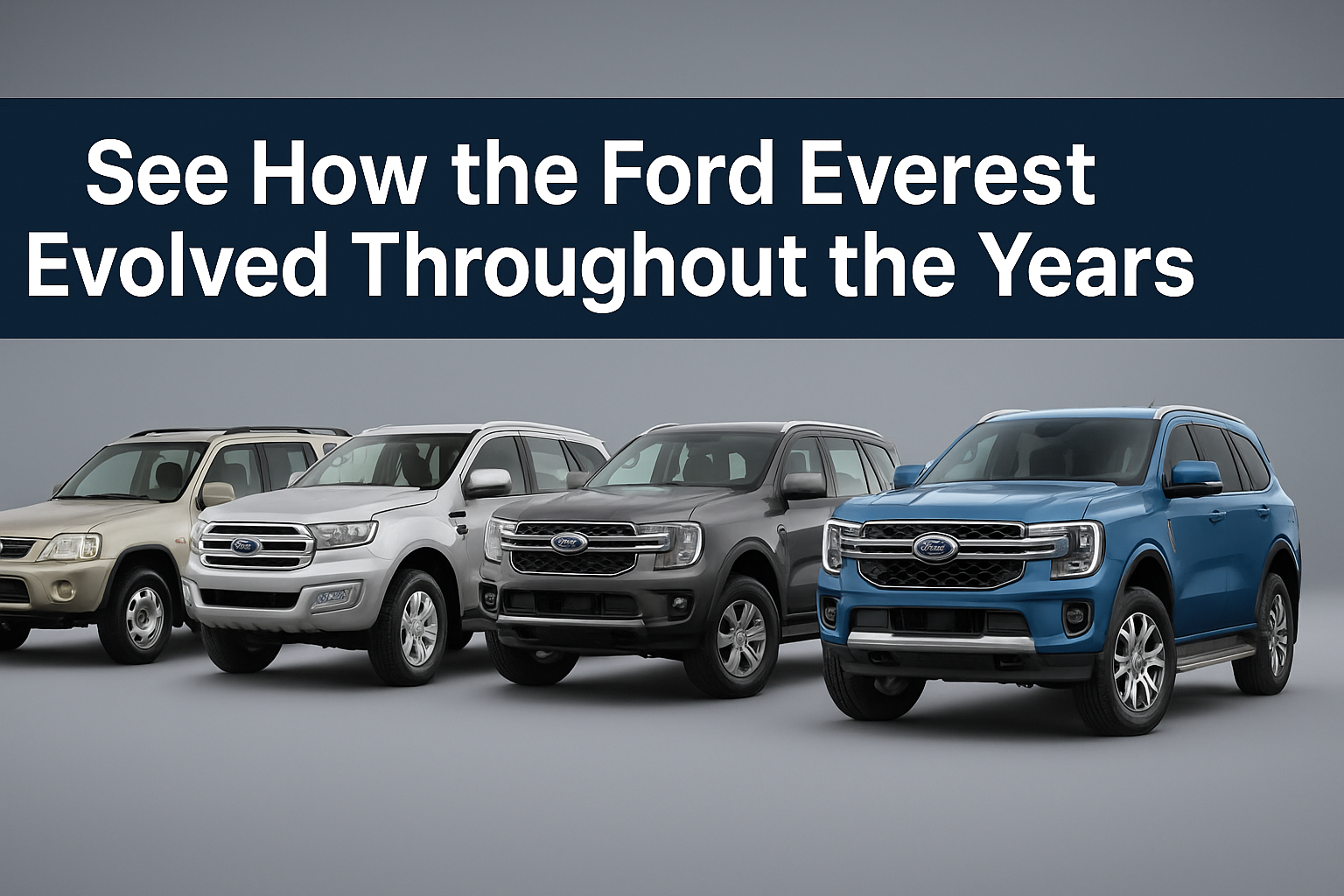
See How the Ford Everest Evolved Throughout the Years
The Ford Everest has been quite the journey, from rugged truck-based beginnings to a refined, tech-laden seven-seater SUV. If you’re curious about how the “new Ford Everest” (and its predecessors) got to where it is today, buckle up: here's a conventional-tone deep dive into its evolution.
The Early Beginnings: First Generation (2003–2006)
The first Ford Everest was launched in March 2003, aimed primarily at Asian markets. It was built on the same ladder-frame chassis as the Ford Ranger pickup, sharing about 60 % of its components, including the 2.5-litre turbo-diesel engine. Because of its pickup roots, the ride and suspension were very much rugged: independent front suspension, but a live axle with leaf springs at the rear, which was great for durability but less ideal for comfort. Still, it filled a growing need for a true 4×4 three-row SUV in markets where off-road capability mattered. The first generation set the tone, big, sturdy, and practical.The Second Generation (2006–2015): A Step Toward Modern Comfort
Moving into the second generation, we see a noticeable shift. While some sources cite 2006 as the facelift start, many treat the “second generation” more fully from 2015 onward. In any case, this era represented a pivot: from pure utility to more driver and passenger comfort, along with updated styling and technology. Underneath, the Everest continued its body-on-frame architecture but improved ride dynamics, especially in later versions of this generation. The design got smoother, less “worktruck,” and more SUV-style. The interior featured better materials and emerging infotainment systems. One metric to note: by its later years, Everest was becoming serious competition in its segment. One review noted that by the end of 2023, the Everest had moved over 15,000 units, about a 6 % edge over its nearest rival. So the second generation marked the “step toward modern comfort” for the Ford Everest: more family-friendly, better equipped, still rugged.The Third Generation (2015–2021): The Tech-Savvy and Refined SUV
Now we enter the third generation of the Everest. According to sources, the model launched globally in 2022, but many markets saw updates around 2015 and onward that qualify as major generation shifts. This phase is about refinement, technology, and moving closer to premium SUV territory while keeping serious off-road DNA. Here are some key highlights of this third-gen era: The body design gets more sophisticated: sleeker lines, larger presence, better interior materials.- Technology leaps: digital instrument clusters, large infotainment screens, more connectivity, and driver-assist features.
- Capability stays high: towing, 4×4 systems, off-road modes—all maintained or improved. For example, the next-gen Everest boasts a braked trailer towing capability of up to 3,500 kg.
- Markets demand it: increased sales, greater global footprint.
The Fourth Generation (2022–Present): Smart, Strong, and Stylish
The latest generation of Everest continues the trend upward. Launched globally around March 1, 2022, it embraces modern luxury, intelligent tech, and rugged utility in equal measure. What stands out:- Design: A longer wheelbase and wider track give it a muscular stance and better stability.
- Tech & comfort: Options like large portrait-oriented touchscreens, full digital clusters, wireless charging, and connectivity via the Ford Pass app.
- Powertrains: Choices include a 3.0-litre turbodiesel V6, 2.0-litre bi-turbo diesels, and, in select markets, a 2.3-litre EcoBoost petrol.
- Off-road & towing chops: The capability remains serious, with features like selectable terrain modes, underbody protection, functional tow hooks, and a high wading depth (~800 mm).
- Global growth: One statistic shows Australia’s Everest sales growth: from 1,245 units in 2015 to 26,494 units in 2024, a huge jump!
The Evolution of Design and Performance
Over the four generations of Everest, we see several clear trends:- Design evolution: From a boxy, utilitarian body based on a pickup to a refined SUV with strong lines, modern lighting, and premium finishes. The silhouette grew more dynamic and less “truck-with-a-roof.”
- Performance & mechanics: While still built on body-on-frame architectures (for durability and off-road capability), suspension, noise-vibration-harshness (NVH), and refinement took big steps forward. Engines grew more advanced, efficient, and powerful.
- Technology & features: Early models had basic comfort features; later ones offer digital clusters, connected services, driver assists, large infotainment screens, and luxury touches like ventilated seats and powered tailgates.
- Capability: While the earliest Everest models were tough, they didn’t always match the ride and comfort of premium SUVs. By the latest generation, Everest delivers both serious off-road/4×4 capability and daily comfort, which is rare in the segment.
- Market positioning & appeal: The Everest has shifted from a primarily niche 4×4 to a credible mainstream three-row SUV option for families, adventurers, and fleet buyers.
What’s Next for the Ford Everest
Looking ahead, what could the Everest do next? A few likely directions:- Electrification/Hybrid powertrains: With global trends pushing toward lower emissions and stricter fuel economy, a hybrid or plug-in variant of the new Ford Everest seems plausible.
- More advanced driver assists & connectivity: As competitors bring more autonomous features, we can expect Everest to further up its tech game: more sensors, smarter 4×4 terrain systems, over-the-air updates.
- Global expansion & localisation: With the SUV market growing in emerging regions, Ford may tailor Everest variants (engine, trim, cost) for those markets.
- Premium/upmarket variant: Given how well-equipped the current Everest is, we may see luxury or “performance SUV” versions with more features, stronger engines, and higher price points.
- Sustainability & materials: Next-gen editions may emphasise lighter materials, recycled components, and improved fuel/energy efficiency.